Geomicrobiology and Sedimentary Geochemistry
Our research
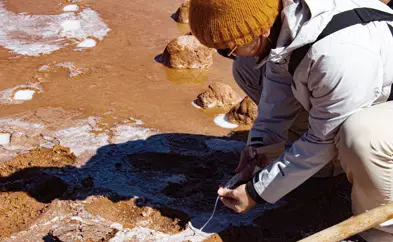
Our research initiative delves into the intricate intersections of geobiology, geomicrobiology, and sedimentary geochemistry/biogeochemistry. Our core objective is to unravel the profound influence of microbial communities on mineral formation, particularly that of carbonate minerals, and their overarching impact on biogeochemical cycles within extreme environmental settings. Ultimately, we aim to decipher the fundamental relationship between microbial mineral genesis and the grand narrative of life’s evolution on Earth.
We employ a robust Earth System Science approach, meticulously integrating field investigations, controlled laboratory experiments, and detailed observations of the sedimentary rock record. This multifaceted methodology allows us to precisely define the boundary conditions that govern mineral formation and diagenesis during critical intervals throughout Earth’s geological history. Critically, biogeochemical parameters derived from our field studies are rigorously applied to replicate natural environmental conditions in our laboratory culture experiments, utilizing microbial communities meticulously isolated from both surface and subsurface environments. This synergistic combination of field and lab-based research is indispensable for accurately evaluating biomineralization processes and for the comprehensive interpretation of the sedimentary rock record, which uniquely preserves the fossilized evidence of microbial metabolism across vast stretches of geologic time.
Our ultimate ambition is to illuminate the intricate links between microbial diversity, metabolic activity, and global biogeochemical cycles, thereby deepening our understanding of the evolution of life on Earth and potentially elsewhere in the universe. Furthermore, our research significantly contributes to re-evaluating the Earth’s fossil record and its critical importance in reconstructing ancient and modern environments, climate dynamics, and ocean chemistry.
Key Research Areas
Our research group is singularly focused on dissecting the intricate interplay between microbial mineral formation, with a particular emphasis on carbonate minerals, and the grand narrative of life’s evolution throughout Earth’s history. We’ve adopted a comprehensive Earth System Science approach, seamlessly integrating rigorous fieldwork, controlled laboratory experiments, and meticulous analysis of the rock record. This holistic strategy allows us to precisely define the biogeochemical boundary conditions that have governed mineral formation and early diagenetic processes during pivotal periods in Earth’s past.
Our methodology is distinctive: it combines in situ field studies with controlled laboratory cultures of microbial communities, carefully isolated from diverse surface and subsurface environments. By meticulously simulating natural conditions within the lab, our goal is to reconstruct the precise environmental parameters that dictate microbial activity and subsequent mineral precipitation. This dual-pronged approach is absolutely fundamental for identifying the core mechanisms of biomineralization and, critically, for interpreting the biosignatures preserved in the geological record. These biosignatures, after all, serve as the fossilized evidence of microbial metabolism spanning vast geological timescales.
Ultimately, our overarching objective is to deeply explore the links between microbial diversity, metabolic activity, biogeochemical cycles, and the broader processes that have shaped life’s evolution on Earth, and potentially, elsewhere in the universe. Our ongoing research significantly enhances our understanding of Earth’s fossil record and its profound importance for accurately reconstructing ancient environments, climate dynamics, and oceanographic changes.
Core Subjects of Study
Our research encompasses several key areas:
- Microbial Geochemistry in (Hyper)saline Environments: We investigate the microbiological, isotopic, and elemental composition of carbonate, phosphate, sulfate, and silicate minerals found in extreme saline conditions.
- Biomineralization in Microbial Mats: A significant focus is on understanding the biomineralization processes of both carbonate and silicate minerals within (hyper)saline microbial mats.
- Microorganisms’ Influence on Key Geological Processes: We examine the critical role of microorganisms in:
- The geochemistry and mineralogy of reservoir rocks, including systems for petroleum, natural gas, and water.
- Carbonate diagenesis and the initial stages of rock formation (lithification).
- The weathering processes that affect carbonate and silicate minerals.
- CO₂ sequestration pathways driven by microbial interactions with minerals.
Current Research Focus
Our laboratory is actively engaged in several cutting-edge research areas, meticulously investigating the multifaceted interactions between microbial life and geological processes:
- Microbial Geochemistry in Extreme Saline Environments: We’re conducting detailed studies on the microbiological, isotopic, and elemental signatures of carbonate, phosphate, sulfate, and silicate minerals found in both saline and hypersaline environments. This work aims to uncover the specific microbial pathways driving mineral formation and alteration in these challenging settings.
- Biomineralization within Microbial Mats: A significant part of our research is dedicated to understanding the intricate processes of biomineralization—specifically concerning carbonate and silicate minerals—as they occur within (hyper)saline microbial mats. These mats are crucial ecosystems for understanding early Earth processes and potential extraterrestrial life.
- Microbial Influence on Earth’s Critical Systems: We are rigorously exploring the pervasive influence of microorganisms across a range of vital geological processes:
- Reservoir Geochemistry: We’re analyzing the impact of microbes on the geochemistry and mineralogy of reservoir rocks, encompassing crucial oil, natural gas, and groundwater systems. This research has direct implications for resource management and exploration.
- Carbonate Diagenesis & Lithification: Our work investigates the microbial role in carbonate diagenesis and the early stages of lithification, shedding light on how sedimentary rocks form and evolve.
- Mineral Weathering Processes: We’re examining how microorganisms contribute to the weathering of both carbonate and silicate minerals, a fundamental process shaping Earth’s surface.
- CO₂ Sequestration: A key area of focus is understanding the mechanisms of CO₂ sequestration through microbially mediated mineral interactions, offering insights into potential natural carbon capture solutions.